
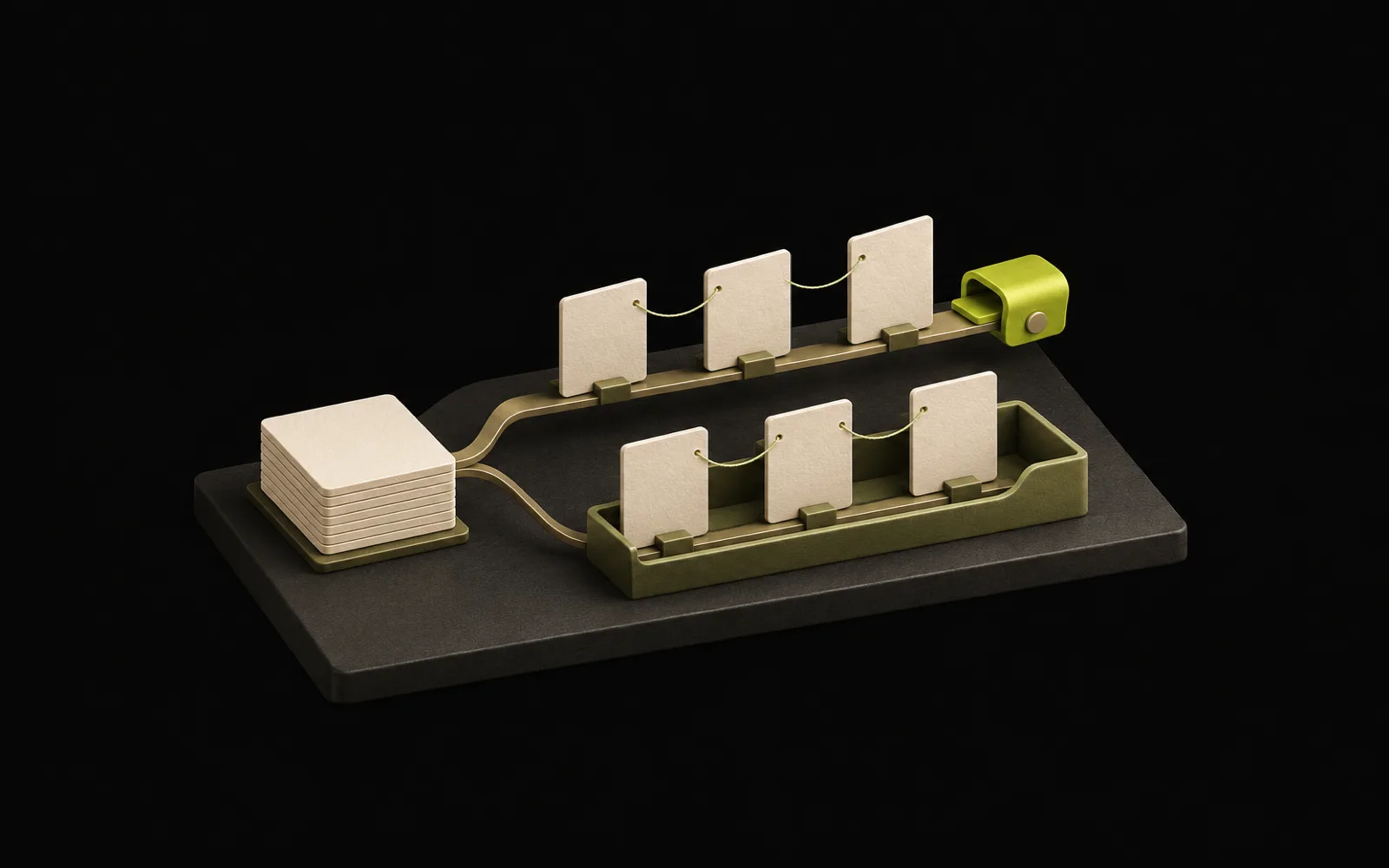
From agent memory and multi-agent orchestration to AI-native version control, a new generation of tools is changing how autonomous software development works. We look at the emerging ecosystem, why VERSY deserves attention, and where we believe agentic workflows are heading.
AI agents can write code. But can they remember how they got there?
For the past two years, much of the AI development conversation has focused on what coding agents can produce. Better models, longer context windows, stronger reasoning, faster code generation and increasingly autonomous execution.
That progress is real. But a different problem is starting to become more interesting.
What happens after an agent finishes its task?
Where do its failed attempts go? How does another agent understand the decisions already made? Can we reconstruct which version of the code was actually tested? And when several agents work on the same problem, who keeps track of which solution was selected and why?
Most of today's development infrastructure was designed around humans writing code, committing changes and reviewing pull requests. AI agents can participate in that workflow, but they also introduce new requirements.
We now have software that can explore multiple implementations, work across sessions, generate large amounts of intermediate state and make decisions at a pace that traditional development processes were not designed around.
The interesting question is no longer just how to make an agent write better code.
It is how to make autonomous work understandable, recoverable and trustworthy.
A growing collection of open-source projects is approaching that problem from different directions. Among them, a new project called VERSY makes a particularly interesting bet: perhaps version control itself needs to change.
The emerging agentic development stack
If we look at projects such as Mem0, SoMem, WikiTrace, Entire, Beads and VERSY, they can initially seem unrelated.
One manages memories. Another tracks coding sessions. Another coordinates agents. One proposes a completely different version control system.
But they are all responding to variations of the same problem: autonomous work needs durable context.
We see four important directions emerging. Our earlier SDLC vs AI-DLC analysis examined development methodology. This article looks at the infrastructure that could make those workflows practical.
1. Memory is becoming infrastructure
A coding agent can have an excellent reasoning model and still repeatedly make the same mistake if it does not retain useful information between sessions.
Projects like Mem0, Hindsight and OpenViking are addressing this through persistent memory and context management.
Their approaches differ. Mem0 focuses on reusable memory infrastructure. Hindsight adds retention, recall and reflection. OpenViking organizes memory, resources and skills into a navigable context structure.
Meanwhile, SoMem, an emerging research project, explores something particularly interesting: allowing agents to maintain and reorganize their own memory through structured documents while preserving links to original evidence.
This changes the relationship between an agent and its context.
Instead of receiving a large prompt containing everything we hope it needs, an agent can retrieve relevant knowledge, inspect previous information and potentially refine what it remembers.
But there is a catch.
Remembering something does not make it correct.
2. From storing memories to verifying experience
WikiTrace, another research project, investigates a weakness in agent memory systems: past experience can actually make an agent perform worse.
A previous execution might produce a lesson that sounds reasonable but leaves out an important constraint. If the next agent trusts that summary without checking the original execution, the memory becomes a source of error.
WikiTrace addresses this by linking insights to their original execution trajectories, allowing agents to inspect the underlying evidence when needed.
This is an important distinction.
A memory system tells an agent what it remembers. An evidence-linked memory system gives it a way to investigate why that memory exists.
We believe this will become increasingly important as agents move into larger engineering projects, where incorrect assumptions can propagate across many tasks and sessions.
It also raises a broader question: should an agent's development history be treated as a collection of disposable logs, or as reusable engineering knowledge?
3. Multi-agent coordination is becoming a real engineering problem
Another group of projects focuses less on memory and more on coordination.
Beads provides persistent, dependency-aware task management designed for coding agents.
Gas Town explores coordinating multiple agents working across development workspaces.
These approaches reflect a natural change in how developers use AI.
Instead of asking one agent to implement an entire feature, we can delegate different approaches or subtasks to several agents.
One agent might investigate a bug, another implement a fix, and a third validate an alternative.
The problem is no longer simply generating code. It is coordinating work, resolving conflicts and deciding what should become the accepted result.
Parallel execution also creates new failure modes. Two agents can overwrite each other's assumptions, work against outdated state or produce implementations that are individually correct but incompatible.
More agents do not automatically mean faster development.
Without structured coordination, they can simply generate more work for humans to sort out.
4. Development history is becoming richer than Git commits
A fourth category worth watching connects code changes to the agent activity that produced them.
Entire integrates with Git to capture coding-agent sessions, prompts, transcripts and checkpoints.
Git AI adds AI attribution to code history, linking generated lines to agents, models and sessions.
These tools recognize something increasingly important.
A commit tells us what changed. The surrounding agent activity can tell us what was attempted, which instructions influenced the change and what happened before the final code appeared.
Git can already retain additional context through notes, branches, commit messages and external CI or review systems. The challenge is that these records are often scattered across tools.
Entire and Git AI aim to make parts of that missing context easier to capture and inspect without abandoning Git.
And that brings us to VERSY.
Meet VERSY: an AI-first version control system
VERSY is a new open-source version control system written in Rust, designed around autonomous software development.
Unlike Entire or Git AI, VERSY is not built as an extension to Git.
It proposes its own version control model.
That is a much more ambitious approach, and one of the reasons we find it worth examining.
VERSY starts from a simple observation: software development is rarely one clean sequence of successful changes.
Developers experiment. Agents attempt alternative fixes. Tests fail. Approaches are rejected. Decisions are reconsidered.
Traditional version control records source history very well, but a great deal of the surrounding process lives elsewhere.
VERSY makes several of those concepts first-class parts of its model:
- Change: The objective or intended piece of work.
- Run: A specific attempt to achieve that objective.
- Workspace: An isolated working directory for that attempt.
- Checkpoint: An exact, immutable snapshot of source state.
- Evidence: A recorded result of a check against a particular checkpoint.
- Candidate and Selection: A proposed result and the recorded decision about which approach to accept.
Consider a relatively ordinary example.
An agent is asked to fix a parser bug. Two different agents investigate it, each starting from the same source state.
One rewrites part of the parser. The other changes input handling.
Both approaches produce code. Both run tests. One passes its checks but introduces an undesirable dependency. The other requires fewer changes and is selected.
In a typical workflow, we may end up with a merged pull request, CI results and some review comments. The unsuccessful attempt may survive in a discarded branch or an old agent conversation.
In VERSY's model, the objective, separate attempts, exact code states, reported checks and selection rationale can all remain connected.
That makes the development process more inspectable.
It also gives the next agent a stronger starting point.
Instead of discovering the same failed approach again, it can inspect the previous Run, the resulting Checkpoint and the recorded reasons for rejection.
VERSY does not itself run the agents or execute their tests. It records the work and information supplied by external actors. Its Evidence records are reports supplied by actors, not independently certified proof of correctness. VERSY does not authenticate those actors, and explanations are not automatically inferred.
Those distinctions matter.
Why we think VERSY is promising
What we like about VERSY is not simply that it stores more development history.
It recognizes that an attempt is a meaningful engineering artifact, even when it fails.
As coding agents become more autonomous, this could become valuable.
A failed approach might reveal a hidden constraint. A rejected implementation might become useful when requirements change. A previous test result could explain why the next agent should investigate a different direction.
There is also something attractive about the explicit connection between code and evidence.
In agentic development, a statement such as "the tests passed" is much more useful when we know exactly which source state was tested, what check was reported and whether that check is still relevant.
VERSY's model offers a foundation for recording that relationship.
But an interesting model is not the same as a proven replacement for Git.
What VERSY still needs to prove
As of 16 November 2026, VERSY documents an experimental v0.3.0 local-first preview under Apache 2.0. Its release status lists validated Linux x86-64 and macOS Apple Silicon targets, with specific OS and filesystem requirements. It also says release artifacts are prepared locally and does not attest that production deployment is complete. Check the download catalog for published artifacts and requirements.
The planned VersyHub remote hosting and shared collaboration infrastructure is not available in this preview.
That is a significant limitation.
Git has decades of tooling, hosting, integrations, IDE support and operational experience behind it.
Replacing that ecosystem requires more than an elegant data model.
VERSY will need to demonstrate practical performance, reliable recovery, useful interoperability, a secure collaboration model and a developer experience that makes switching worthwhile.
It is also worth asking whether some of its concepts could eventually be implemented on top of Git.
Entire is already exploring the Git-compatible direction, while VERSY is testing a native alternative.
We do not know which approach will win.
But we think VERSY is asking a worthwhile question, and that alone makes it a project worth watching.
Where we think agentic workflows are going
Looking at these projects together reveals a pattern.
The ecosystem is evolving from tools that execute isolated instructions into systems that manage long-running work.
Our view is that several changes will define the next generation of agentic development.
1. Agents will need shared, persistent project knowledge
Today, every new agent session can feel like onboarding a new developer who has never seen the project.
We compensate with instruction files, documentation, repository searches and increasingly elaborate context management.
That approach works, but it has limits.
Future workflows will likely combine project knowledge, previous execution experience, task state and verified development history.
The important change will not be the ability to store everything.
It will be selecting the right context at the right moment, while preserving enough original information to investigate questionable memories.
2. Agent harnesses will become more important than individual prompts
A good system prompt can guide an agent. It cannot, by itself, provide durable execution state, access control, conflict management, approval gates or trustworthy evaluation.
Those responsibilities belong to the surrounding infrastructure.
We expect agent harnesses and orchestration layers to become increasingly important as development teams coordinate multiple specialized agents.
The strongest implementations will combine probabilistic reasoning with deterministic controls.
An LLM may decide which implementation to investigate. A workflow engine should still be able to enforce permissions, dependencies, retry policies and required verification steps.
Not every decision needs another LLM call.
3. Evidence and provenance will become central to trust
When humans write most of the code, teams can often reconstruct intent through conversations, tickets and code reviews.
When agents generate many changes, that implicit knowledge becomes less reliable.
We expect provenance to become a much more important part of the development process.
Teams will want to know which agent made a change, which context it received, which checks were performed, what was actually accepted and who authorized the result.
Observability tools such as Langfuse help examine agent execution and evaluations. Development-history tools such as Entire and VERSY approach related problems from the perspective of source changes.
These are different kinds of evidence, and future workflows may need both.
4. We will manage decisions, not just generated code
The value of an autonomous development system should not be measured by how many lines of code its agents produce.
More useful measures include successful task completion, regression rates, repeated failed attempts, review effort and the time required to reach a validated implementation.
Imagine an agent beginning a task by retrieving three things:
- What the project currently looks like.
- What approaches have already been attempted.
- What evidence supports the decisions made so far.
That is much closer to productive engineering work than simply feeding the latest repository into a large context window and asking the model to start.
This is the direction in which tools such as SoMem, WikiTrace and VERSY become complementary rather than competing solutions.
How VERSY could fit into that future
We do not think every agent framework needs to become a version control system, and we do not think a version control system should necessarily become an agent orchestrator.
A more interesting architecture allows each component to do its job well.
Imagine a future development workflow where:
- An orchestrator receives an engineering objective and delegates several approaches to specialized coding agents.
- A persistent memory system provides project conventions, relevant architecture and lessons from previous work.
- Each agent works in an isolated environment, producing source checkpoints and execution records.
- A verification layer runs appropriate checks and evaluates the outcomes.
- A development-history system records the attempts, exact source states, reported evidence and reasons for selecting a particular implementation.
- The next agent can retrieve the relevant history rather than starting from scratch.
In that architecture, VERSY could become the system responsible for durable, structured development history.
SoMem or Hindsight-like approaches could organize reusable knowledge. WikiTrace-like methods could help agents inspect the evidence behind remembered lessons. An orchestrator could manage delegation, while observability tools monitor execution.
This is a conceptual architecture, not a claim that these products already integrate with each other.
The opportunity is in connecting these capabilities without forcing every tool to solve every problem.
If VERSY evolves toward stable APIs, agent integrations and collaborative workflows, its native representation of attempts and decisions could become particularly valuable.
It could give coding agents something they often lack today: a reliable record of how an engineering result came to exist.
Will agentic tools replace Git, developers or traditional workflows?
We are skeptical of predictions that a new technology will suddenly make the entire existing stack obsolete.
Git is unlikely to disappear simply because agents need richer histories.
Developers will still need to reason about architecture, constraints, reliability and trade-offs, even if agents increasingly perform the implementation work.
And a multi-agent workflow does not remove the need for software engineering discipline.
In many cases, it makes that discipline more important.
What we do expect to change is the level at which developers work.
Less time may be spent manually producing individual implementations. More attention may move toward defining objectives, designing constraints, reviewing alternatives and validating results.
The best tools will make those responsibilities easier.
They will not hide the complexity behind another impressive dashboard.
They will make autonomous work easier to understand and control.
Final thoughts: the next wave is about engineering memory
The first wave of AI coding tools helped developers write software faster.
The next wave is beginning to address what happens when agents perform substantial amounts of the development process themselves.
That requires more than better prompts.
It requires persistent memory, coordinated execution, reliable evidence, recoverable history and clear ownership of decisions.
Mem0, Hindsight, OpenViking and SoMem are exploring how agents retain and organize context. WikiTrace investigates how to verify reusable experience. Beads and Gas Town address persistent tasks and multi-agent coordination. Entire and Git AI enrich development history within Git.
And VERSY takes a more radical approach by questioning whether the version control model itself should evolve.
We find that direction worth investigating.
VERSY is still early, and it would be premature to predict widespread adoption. But its underlying idea deserves attention: the future of autonomous software development may require us to version not only the code, but also the attempts, evidence and decisions behind it.
That could be one of the more important changes in how we engineer software with AI.
The question is no longer just whether an agent can finish the task.
It is whether the next agent, or the next developer, can understand what happened, trust the result and continue from there.
That is where we believe the future of agentic development is heading.
Mr.D's perspective is an independent technical assessment of publicly available projects and their documented capabilities. VERSY and the other projects discussed are third-party initiatives. This article is not a sponsored review or a claim of hands-on production validation.